
About 4 min read
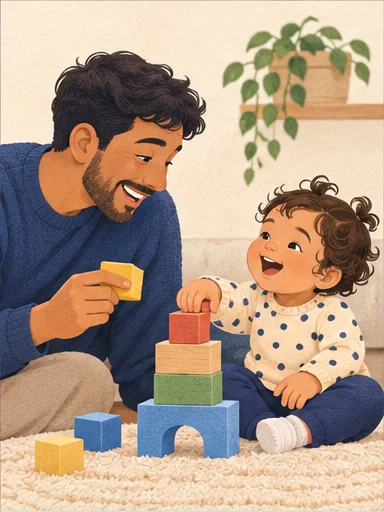
Illustration
Key takeaways
- Notice what your child understands as well as how they communicate.
- Respond to gestures and words, then model one small addition.
- Share concerns early and include examples from all home languages.
What does “late talker” mean?
If your toddler points to the fridge, takes your hand to the snack drawer, or grunts to tell you what they want, you’re already seeing communication. You may still wonder why spoken words are coming slowly. Clinicians sometimes use the term late language emergence when a young child’s language is developing later than expected and no other developmental disability has been identified. It describes a pattern that needs attention and follow-up. The label alone cannot tell you what is causing the delay or predict your child’s future.
What might language look like around age two?
ASHA’s 19-to-24-month guide describes a growing vocabulary and the emergence of combinations such as “Mommy sit” or “more mango.” In research on English-speaking toddlers, an expressive vocabulary of fewer than 50 words and no two-word combinations by 24 months is one commonly used research marker for late language emergence. This marker alone cannot establish a diagnosis. A professional considers much more than the number. They ask how the child learns new words, whether combinations are spontaneous, and how the child communicates with different people. A word approximation used consistently can be meaningful even if the child’s pronunciation sounds different from an adult’s.
Expressive language is how a child conveys a message through words or other means. Receptive language is what they understand. Think about how your child responds when you say “Find your cup” and you aren’t pointing at it. Contrast that with what they do to request their cup. A child may understand many words and use few, while another may need support with both. Gestures, signs and communication devices can tell you a great deal about how a child gets a message across.
Will a late talker catch up?
Some toddlers make substantial gains and later score within expected ranges. Others continue to need language or literacy support. Understanding spoken language and the rate of vocabulary growth help clinicians interpret what they are seeing, but neither can predict one child’s path. Progress also looks different across environments. A toddler may talk more with a familiar grandparent than at a busy playground. Write down examples from both settings so a clinician can see what helps.
Follow their lead and build on what they do
Sit beside your child and notice what they choose. If they roll a ball toward you, roll it back and say, “Ball rolls.” If they point at a bird, say, “A bird! It flew up.” Say one short phrase and leave a little room for your child to respond. A look, a sound, a movement or a word can all keep the exchange going. You can add a word to their message without expecting them to repeat it. “Dog” might become “dog sleeping” or “big dog.”
Try one natural opportunity at a time. Set out two familiar books and say, “Truck book or bear book?” Watch for a reach or glance and name the one they chose. At the end of a favorite song, pause briefly where a familiar word usually comes next. If your child seems ready to move on, finish the song together or switch activities. Keep essentials such as food, water and comfort available regardless of how your child responds.
What if we use more than one language?
Continue using the languages that help your family connect. Exposure to two or more languages does not cause a language disorder. A child may know one word with grandparents and a different word for the same idea at daycare. Share examples from every language the child hears or uses. Ask other caregivers what they notice and tell the clinician who speaks each language with the child and during which routines. A bilingual evaluation or one supported by an interpreter can give a fuller picture.
When to ask for guidance
Bring concerns to the pediatrician or a speech-language pathologist when words are growing very slowly, combining words remains difficult around age two, understanding familiar directions is hard, or communicating needs is often frustrating. Report any loss of previously used skills promptly and ask about a hearing evaluation when responses to sounds or voices are inconsistent. Florida families can contact their local Early Steps program about evaluation for eligible infants and toddlers under age three. Families can make a referral themselves and ask what happens next. Jet 2 Speech plans to offer services through Florida Early Steps in 2027.
What should I bring to that first conversation?
Use the observation checklist to collect a few everyday examples. Write what happened, what your child did, which language was used and what made the exchange easier. Include something your child enjoys and does well. For example, “During play with Dad, pointed to a closed box and said ‘open’ after Dad waited.” A few observations like that can help you explain what you’re seeing without trying to recreate it in an appointment.
Communication Observation Checklist
Check examples you have noticed around 24 months. Leave an item blank if you are unsure. The boxes are for your own reflection. The tool calculates no score and sends or saves no answers.
Free downloadable resources
Related articles
- Speech and Language Milestones: Birth to Age 5
- Does Bilingualism Cause Speech Delays?
- 10 Everyday Ways to Encourage Your Child's Language Development
Clinical references
- ASHA · Late Language Emergence
- ASHA · Communication Milestones: 19 to 24 Months
- ASHA / CHSA · Learning More Than One Language
- CDC · Milestones by 2 Years
- American Academy of Pediatrics · Language Delays in Toddlers
- Florida Early Steps · Eligibility and Screening
For general education. It does not replace an individual evaluation or professional advice. Educational Disclaimer.
Have questions about our speech-language services in Clearwater and nearby communities? Ask about a free virtual consultation.